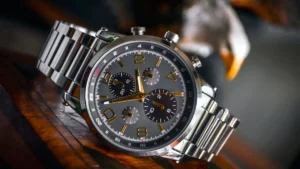

If you’ve ever looked closely at a Rolex watch, you’ve likely noticed the words “Oyster Perpetual” emblazoned on nearly every dial. But why would one of the world’s most prestigious luxury watch brands choose a name inspired by a shellfish? The answer lies in a groundbreaking innovation that transformed watchmaking forever.
So, what does Rolex Oyster mean? Simply put, “Oyster” refers to Rolex’s revolutionary waterproof watch case, first introduced in 1926. Just like an oyster shell hermetically seals a precious pearl inside, the Rolex Oyster case protects the delicate watch movement from water, dust, and external elements. It was the world’s first truly waterproof and dust-proof wristwatch, setting a new standard for durability and reliability.
In this article, you’ll learn the origin of the Oyster name, how the case works, the difference between “Oyster” and “Oyster Perpetual,” which Rolex watches feature it, and why this nearly 100-year-old innovation still matters today. By the end, you’ll understand why the Oyster case is more than just waterproofing—it’s a symbol of Rolex engineering and legacy.
The Simple Answer: Oyster Means Waterproof
In plain terms, “Oyster” is Rolex’s trademark for their waterproof watch case. Introduced in 1926, it was the world’s first practical wristwatch that could resist water, dust, and moisture while maintaining elegance and wearability.
The inspiration comes from the oyster mollusk. Just like oysters hermetically seal their shells underwater to protect the pearl inside, Rolex’s Oyster case creates a protective barrier around the movement.
Hans Wilsdorf, Rolex’s founder, coined the name after realizing at a dinner party that both the shell and his waterproof case required special tools to open. The parallel between the hermetic seal of a shellfish and a waterproof watch captivated him.
Today, every Rolex Oyster guarantees a minimum of 100 meters (330 feet) water resistance, with professional dive models going even deeper: the Submariner reaches 300 meters, the Sea-Dweller 1,220 meters, and the Deepsea an astounding 3,900 meters. Each watch is tested to exceed its stated water resistance, making Oyster synonymous with reliability.
The Revolutionary 1926 Invention
Before 1926, wristwatches were fragile. Water was a constant enemy, causing rust, dial damage, and complete movement failure. Dust was equally destructive. Early waterproof attempts were clumsy and impractical.
Hans Wilsdorf wanted a watch that could withstand real-world conditions. After years of experimentation, Rolex introduced the Oyster case, featuring a three-piece screw-down system:
Screw-Down Bezel
The front of the case screws into the middle, creating a tight seal at the crystal. The fluted design allowed watchmakers to grip it firmly.
Screw-Down Case Back
Threads into the middle section, hermetically sealed with a gasket. Opening required a special tool, like the oyster shell.
Screw-Down Winding Crown
The most vulnerable point, designed to thread tightly against the case, creating a watertight seal via an internal clutch.
The first Oyster (33mm, 21K gold) was practical, elegant, and durable—a stark contrast to previous waterproof prototypes. Rolex had solved a centuries-old problem: how to create a wristwatch resistant to water and dust without compromising style.

The Legendary Mercedes Gleitze Swim
Rolex proved the Oyster’s capabilities in 1927 during Mercedes Gleitze’s historic English Channel swim. On October 7, Gleitze, the first British woman to attempt the 21-mile swim, braved freezing water for over ten hours.
Her Rolex Oyster, worn around her neck outside thermal clothing, remained fully functional despite immersion. Independent verification confirmed zero water ingress. Rolex capitalized on this triumph with a full-page Daily Mail ad, cementing the Oyster’s reputation as the world’s first truly waterproof watch.
This event established Rolex’s identity: adventure, innovation, and real-world proof of durability—a legacy that continues to this day.
How the Oyster Case Actually Works
The genius of the Oyster lies in its precise engineering. The case comprises three main components that screw together to form multiple sealed zones. O-rings and gaskets at critical junctions create a hermetic seal akin to a submarine hatch.
Step-by-Step
Middle Case
Carved from a single block of Oystersteel, gold, or platinum. Provides structure and houses integrated lugs.
Case Back
Fluted edges thread into the middle case, gasket ensures waterproofing. Requires a Rolex tool for opening.
Bezel and Crystal
Sapphire crystal mounted on a gasket; bezel clamps it in place.
Winding Crown
Threads onto a crown tube, sealing with Twinlock or Triplock systems. Twinlock (1953) has two gaskets for 100m water resistance; Triplock (1970) has three gaskets for professional dive models.
Every Oyster undergoes rigorous testing, often exceeding its rated depth by 10–35%, depending on the model.
Oyster vs. Oyster Perpetual: Understanding the Difference
| Term | Meaning / Technology | Details | Examples / Notes |
|---|---|---|---|
| Oyster | Waterproof Case | Screw-down crown, minimum 100m water resistance, protects movement from water and dust | All modern Rolexes except Cellini and some vintage models |
| Perpetual | Automatic Self-Winding Movement | Introduced in 1931, the rotor spins with wrist motion, keeping the watch running without manual winding | Most Rolex models, including entry-level and professional watches |
| Oyster Perpetual | Combination of Oyster + Perpetual | Waterproof case + self-winding movement | Submariner, Daytona, Datejust; also refers to an entry-level time-only model |
| Exceptions | Non-Oyster / Special Models | Dress watches or vintage watches without a waterproof case or automatic movement | Cellini, Oysterquartz, hand-wound vintage Daytonas, 1908 collection |
The Oyster Professional Line
In 1953, Rolex launched Professional models designed for extreme conditions. These watches pair the Oyster case with specialized features:
Rolex’s Oyster Professional line combines the legendary Oyster case with specialized features for professional activities.
The Submariner and Submariner Date are iconic dive watches, water-resistant up to 300 meters, designed for recreational and professional diving.
For extreme deep-sea exploration, the Sea-Dweller and Deepsea models withstand depths from 1,220 meters up to an astonishing 3,900 meters, featuring robust construction and helium escape valves to handle saturation diving.
Pilots and frequent travelers rely on the GMT-Master II, which displays dual time zones for international aviation.
The Explorer and Explorer II are built for mountaineering and outdoor expeditions, offering durability, legibility, and resistance to harsh environments.
For racing and motorsports enthusiasts, the Cosmograph Daytona combines precision chronograph functions with Oyster durability, enabling accurate timekeeping at high speeds.
Across the professional line, these watches share the hallmark Oyster case, Perpetual self-winding movement, and enhanced specifications beyond standard models, making them trusted tools for adventurers, athletes, and professionals alike.
All feature Oyster cases, Perpetual movements, and enhanced specifications, including Triplock crowns for dive models.
Modern Oyster Case Features & Innovations
Nearly a century after its invention, the Rolex Oyster case continues to evolve with innovative features that keep it at the forefront of modern watchmaking.
Oystersteel, a high-grade 904L stainless steel, offers superior corrosion resistance and maintains a brilliant polish longer than conventional steels.
The Cerachrom bezel, introduced in 2005, is made of virtually scratchproof ceramic that resists fading, ensuring the watch looks pristine even after years of use.
For extreme deep-sea exploration, the 2008 Ringlock System provides a three-layer case architecture capable of withstanding pressures at depths up to 3,900 meters, while the Helium Escape Valve, patented in 1967, allows professional dive watches to release built-up gases during decompression safely.
Enhancing usability in low-light conditions, the Chromalight display emits a long-lasting luminescence on hands and hour markers.
Additionally, the iconic Cyclops lens, introduced in 1953, magnifies the date display 2.5 times for easier reading.
Together, these continuous improvements ensure that the Oyster remains not only a symbol of Rolex heritage but also a cutting-edge, functional tool for modern watch enthusiasts.

Why the Oyster Name Still Matters Today
“Oyster” remains one of Rolex’s most important symbols, representing reliability, heritage, and practical value.
Its durability ensures that the watch can withstand water, dust, and harsh environments, giving wearers confidence in everyday life and adventurous pursuits alike.
The name also carries a rich brand legacy, linking modern Rolex watches to the groundbreaking 1926 invention and the famous Mercedes Gleitze English Channel swim that proved its waterproof design.
Beyond reliability, the Oyster delivers practical benefits: owners can swim, shower, or dive without worry, making it a true all-purpose timepiece.
Its enduring quality also supports value retention, enhancing resale potential and collector appeal. The Oyster’s influence on the watch industry is significant, as it set global standards for waterproofing and paved the way for sports and professional tool watches.
Finally, the Oyster has become a cultural icon, worn by explorers, athletes, and world leaders, cementing its place as a timeless symbol of precision, adventure, and human achievement.
Common Questions About Rolex Oyster
Q1: Does “Oyster” mean waterproof?
A: Yes, all Oyster-cased Rolexes resist at least 100m water depth; professional models exceed this.
Q2: Are all Rolex watches Oysters?
A: Almost all, except the Cellini/1908 collection and some vintage models.
Q3: Difference between Oyster and Oyster Perpetual?
A: Oyster = waterproof case; Perpetual = self-winding movement; together = both features.
Q4: Why the name “Oyster”?
A: Inspired by the oyster shell, which hermetically seals and protects its pearl, like the watch movement.
Q5: When was the Oyster case invented?
A: 1926, making it nearly 100 years old, and the world’s first practical waterproof wristwatch.
Final Thoughts
The simple answer to “what does Rolex Oyster mean” is that it signifies the revolutionary waterproof watch case introduced in 1926. Named after the oyster mollusk, its three-piece screw-down construction hermetically protects the movement from water, dust, and external elements. Proven during Mercedes Gleitze’s historic swim, the Oyster set Rolex apart as a brand of reliability, durability, and innovation.
Nearly a century later, the Oyster case remains the cornerstone of Rolex engineering—from the entry-level Oyster Perpetual to the extreme Deepsea. It’s more than just waterproofing; it represents nearly 100 years of precision, endurance, and horological excellence. When you see “Oyster” on a Rolex dial, you’re seeing the legacy of one of the most influential inventions in watchmaking history.
FAQs
-
What does Rolex Oyster mean?
It’s Rolex’s waterproof case, protecting the movement from water, dust, and external elements.
2. Can I swim with a Rolex Oyster?
Yes, all Oyster watches resist at least 100m; professional models go deeper.
3. Difference between Oyster and Oyster Perpetual?
Oyster = waterproof case; Perpetual = self-winding movement; together = both features.
4. When was the Oyster case invented?
In 1926, Rolex introduced the first practical waterproof wristwatch.
5. Are all Rolex watches Oysters?
Most modern Rolexes are Oyster, except Cellini, 1908, and some vintage models.