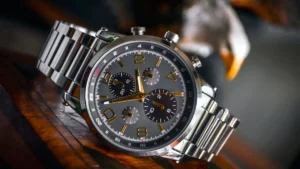

If you’ve ever glanced at a Rolex Submariner, Explorer, or GMT-Master II, you’ve probably noticed the unique three-pointed star on the hour hand.
Collectors and enthusiasts instantly recognize it, yet many casual observers assume it’s simply a design flourish or even a nod to the German car brand.
So why does Rolex have Mercedes hands? Contrary to popular belief, these hands have nothing to do with Mercedes-Benz.
The real story lies in engineering brilliance and practical innovation. Rolex didn’t copy a car logo; they refined a concept to enhance readability, durability, and luminescence.
This design first appeared on tool watches, such as the Submariner and Explorer, and has endured across decades because it solved multiple functional challenges.
Today, the “Mercedes” hand is more than a stylistic quirk; it’s a hallmark of Rolex’s professional sports watches, instantly recognizable and a symbol of precision.
Throughout this article, we’ll explore what Mercedes hands are, debunk popular myths, reveal the functional genius behind the design, and examine its lasting impact on the watchmaking world.
What Are Mercedes Hands?
Mercedes hands are Rolex’s signature hour hands, distinguished by a circular tip divided into three sections by metal spokes, forming a star pattern.
This openwork “star” resembles the Mercedes-Benz logo, which is why watch enthusiasts nicknamed them “Mercedes hands,” though Rolex never officially uses this term in marketing. In technical documentation, Rolex sometimes refers to them as “Mercedes-style hands.”
Visually, the hour hand starts broad at the base, tapers toward the center, and ends in a round tip segmented by three metal arms. The design allows for luminescent material to be applied securely, enhancing readability in low-light or underwater conditions.
Models Using Mercedes Hands
Rolex has incorporated Mercedes hands into many professional tool watches:
-
Submariner
-
Sea-Dweller
-
GMT-Master II
-
Explorer & Explorer II
-
Yacht-Master
-
Air-King
Models Without Mercedes Hands
Several Rolex collections deliberately avoid this design:
-
Datejust
-
Day-Date
-
Cellini
-
Oyster Perpetual
-
1908
-
Daytona
By understanding which watches use Mercedes hands and which do not, collectors can quickly differentiate between Rolex’s tool watch philosophy and their more dress-oriented timepieces.
The Popular Theories (Debunked)
Over the years, several theories have tried to explain the Mercedes hands’ origin—most of them incorrect. Let’s examine and debunk them.
The Mercedes-Benz Connection Theory
Some assume Rolex paid homage to the luxury car brand due to the visual similarity. In reality, there is zero official connection between Rolex and Mercedes-Benz.
The resemblance is purely coincidental. While the three-pointed star might look like a car logo, Rolex never endorsed or referenced it. The design’s purpose is strictly functional, not branding.
The “Land, Sea, and Air” Theory
A popular myth suggests that the three points symbolize Rolex’s exploration watches: Explorer (land), Submariner (sea), and GMT-Master (air). While poetic, this doesn’t hold up historically:
-
Mercedes’ hands appeared on the Explorer ref. 6150 in 1953.
-
Submariner ref. 6204 was released the same year, but initially without Mercedes’ hands.
-
GMT-Master was launched in 1954, a year later.
The timeline clearly disproves the idea that the three points were intended as a symbolic reference to land, sea, and air.
The Mercedes Gleitze Tribute Theory
Mercedes Gleitze, the first Englishwoman to swim the English Channel in 1927, famously wore a Rolex Oyster during her swim. Some speculate that the hands were named after her.
However, the hands appeared decades later and were not tied to her feat. The nickname comes from the hands’ visual similarity to the Mercedes-Benz star, not the swimmer.
The Hans Wilsdorf German Heritage Theory
Another theory claims the hands were a tribute to founder Hans Wilsdorf’s German roots. This theory is weak: Wilsdorf founded Rolex in England, later moved operations to Switzerland, and was pro-Allied during WWII. Copying a German automotive logo for nationalistic reasons is highly unlikely.
The Real Reason: Functional Brilliance
The true genius of Mercedes hands lies in their functionality, not symbolism. Rolex’s design solves multiple engineering challenges, making them ideal for professional tool watches.
The Cathedral Hands Evolution Theory
Mercedes hands are an evolution of “cathedral hands,” a popular design in the 1920s–1930s. Cathedral hands feature a broad base tapering into a pointed tip with open spaces for readability. Rolex adapted this style for sports watches, enlarging the hands and adding the three-spoke framework to improve luminescence and legibility.
The Three Primary Functional Benefits
Luminous Material Optimization
Rolex faced a challenge: how to apply luminescent material on the hour hand without compromising durability. A solid circle of lume could crack or detach over time.
The Mercedes hand’s three-spoke design allows the luminescent compound to sit securely in three sections, supported by metal arms. This maximizes brightness while maintaining structural integrity.
Instant Legibility and Differentiation
Tool watches require split-second readability. The Mercedes hand is easily distinguishable from the sword-shaped minute hand and lollipop-style seconds hand.
For divers, this ensures accurate bottom time tracking. For pilots using GMT watches, it allows for immediate identification of the hour hand amid multiple time zones.
Visual Clarity When Hands Overlap
The open circular tip ensures visibility even when the hour and minute hands cross. On white or bright dials, such as the Explorer II Polar, the three-section design prevents confusion and improves contrast.
In essence, the Mercedes hand balances luminous efficiency, legibility, and durability—an elegant engineering solution.
The Design’s Impact and Legacy
Rolex Mercedes hands have transcended their original functional purpose to become an iconic symbol of the brand itself.
While initially designed to optimize legibility, durability, and luminescence for professional tool watches, the hands have grown into a visual shorthand for Rolex’s commitment to precision and reliability.
Their instantly recognizable three-pointed star design is now synonymous with luxury, technical excellence, and a heritage of innovation that spans decades.
Today, it is estimated that around 60% of all dive watches from Rolex and other brands adopt some form of Mercedes-style hour hand.
This widespread adoption underscores Rolex’s profound influence on the watch industry. Competing watchmakers have emulated the design not only for aesthetic reasons but also for its functional superiority.
The Mercedes hand has become a benchmark for professional diving and aviation watches, serving as a model of how practical design can evolve into a defining brand signature.
Rolex’s secrecy and minimal commentary on design origins have added to the mystique of the Mercedes hand. Unlike other watch brands that publicize every design choice, Rolex allows the hands to speak for themselves.
Over decades, despite updates to the Submariner, Sea-Dweller, GMT-Master II, Explorer, and Explorer II, the Mercedes hand has remained remarkably consistent.
This continuity reinforces the idea that form follows function in Rolex’s design philosophy, where practical solutions become timeless icons.
Notable exceptions, such as the 2023 Rolex 1908, demonstrate the brand’s willingness to adapt the concept without abandoning its functional principles.
The 1908 features a simplified ring instead of the traditional three-pointed star, reflecting Rolex’s approach to evolution: maintain clarity, durability, and legibility while refining the aesthetic.
Beyond technical advantages, the Mercedes hand has achieved cultural significance in horology. Watch enthusiasts, collectors, and even casual observers immediately recognize it as a hallmark of Rolex’s professional sports watches.
The term “Mercedes hand” has entered the horological lexicon, now understood to represent precision, durability, and readability under extreme conditions.
It has become a symbol of Rolex’s ability to marry innovation with tradition, combining engineering excellence with instantly recognizable design cues.
In essence, the Mercedes hand is not just an hour hand—it is a legacy element. It communicates function, heritage, and quality at a glance.
For collectors, spotting a Mercedes hand evokes trust in the watch’s capability. For competitors, it sets a design standard that is hard to surpass. For Rolex, it remains a silent ambassador of their philosophy, a perfect example of how thoughtful engineering can transform a simple functional component into a global icon.
Technical Details Worth Knowing
Rolex Mercedes hands are more than just visually distinctive—they are a marvel of engineering precision. At the core of their functionality is the luminescent material applied within the three sections of the hand.
Historically, Rolex used tritium, a radioactive compound that emitted a soft glow in the dark. Tritium was eventually replaced by Luminova in the late 1990s, providing a brighter and safer alternative, and today Rolex uses Chromalight, a proprietary luminescent material that glows a vibrant blue for up to eight hours, offering superior visibility in low-light conditions.
The three-spoke framework of the Mercedes hand is crucial to maintaining the integrity of the luminescent material.
A solid circle of lume would be prone to cracking or detachment due to the expansion and contraction of metal under temperature changes, daily wear, or underwater pressure.
By dividing the luminescence into three separate sections, the metal spokes act as a support structure, securing the luminous material and ensuring long-term durability without sacrificing brightness.
This design allows maximum light emission while maintaining structural integrity even in extreme environments, such as deep diving with the Submariner or high-altitude aviation with the GMT-Master II.
The geometry of the hand is also carefully engineered. Rolex calculates the precise length, width, and diameter of the circular tip to maintain perfect proportions relative to each dial.
The circular tip is not too large, which could obscure the dial markings, nor too small, which could reduce the luminescent surface area.
This balance ensures that the hour hand is instantly distinguishable from the minute and seconds hands, even in conditions of limited visibility.
Additionally, the three-part division enhances readability when hands overlap, a common challenge in watch design.
For example, when the hour and minute hands cross, the open spaces within the Mercedes hand allow the wearer to see the dial clearly, avoiding confusion in timekeeping.
This feature is particularly important on professional tool watches where split-second accuracy matters, such as timing a dive or monitoring a second time zone.
Finally, the materials themselves are a combination of durable stainless steel or precious metal alloys for the spokes, paired with advanced luminescent compounds.
This ensures that the hands remain resistant to corrosion, mechanical shocks, and water pressure while providing consistent brightness.
Rolex’s meticulous attention to these technical details demonstrates why the Mercedes hand is more than a design flourish; it’s a carefully optimized functional component that exemplifies the brand’s commitment to precision, durability, and usability in real-world conditions.
Conclusion
So, why does Rolex have Mercedes hands? The answer is simple: function over symbolism. These hands embody Rolex’s philosophy of engineering elegance—designs that solve real problems.
Despite myths connecting them to cars, tributes, or secret symbolism, the hands’ primary purpose is practical: to maximize luminescence, improve legibility, and ensure durability. Rolex’s secrecy adds mystique, but the design itself communicates everything a professional watch should.
Next time you glance at a Submariner or Explorer, appreciate the Mercedes hand—not just as a design feature, but as decades of refined, functional innovation. Every curve, spoke, and lumed section represents Rolex’s mastery of form and function.
FAQs
1. Are Rolex Mercedes hands related to Mercedes-Benz?
No, the resemblance is coincidental; the design is purely functional.
2. Which Rolex models have Mercedes hands?
Submariner, GMT-Master II, Explorer, Explorer II, Sea-Dweller, Yacht-Master, Air-King.
3. Why are they called Mercedes hands?
The watch community nicknamed them due to their visual similarity to the Mercedes-Benz logo.
4. Do all Rolex watches have Mercedes hands?
No, dress models like Datejust, Day-Date, Cellini, and Daytona do not use them.
5. What is the main function of Mercedes’ hands?
To maximize luminescence, readability, and clarity in professional tool watches.